

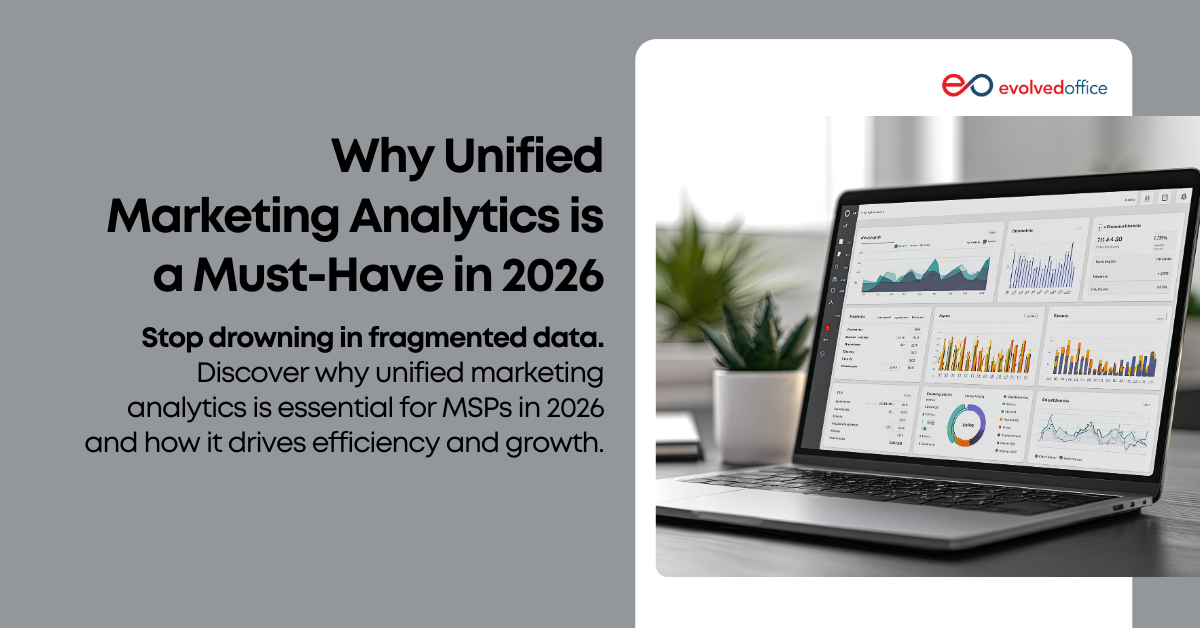
Let’s face it: trying to track your marketing performance today feels a lot like trying to solve a jigsaw puzzle where half the pieces are from a different box, three are missing, and the dog just ate the corner edge.
You have email open rates over here, website traffic stats over there, and social media engagement metrics floating somewhere in the cloud. You’re drowning in data, yet starving for actual insights.
It’s 2026, folks. We have self-driving cars and AI that can write poetry, but most businesses are still manually exporting CSV files to figure out if their last campaign actually made any money. It’s messy, it’s inefficient, and quite frankly, it’s driving us all a little bit crazy.
If you’re a Managed Service Provider (MSP) or Business Service Provider (BSP), you know this pain intimately. You are expected to be the masters of efficiency for your clients, yet your own marketing data often looks like a digital crime scene. The solution isn’t just “more data”—it’s better, cleaner, and more connected data. It’s time to stop guessing and start knowing.
The High Cost of Fragmented Data
We live in an era of app overload. The average marketing department uses upwards of 12 different tools to manage their campaigns. You’ve got one tool for email, another for social scheduling, a third for your CRM, and maybe a fourth just for analytics. While each tool might be great on its own, together they create a siloed nightmare.
When your data lives in isolation, you lose the big picture. You might see that a prospect opened an email, but you miss the fact that they also visited your pricing page three times and downloaded a whitepaper. Without connecting these dots, you’re flying blind. This fragmentation leads to wasted budget and missed opportunities. In fact, poor data quality costs organizations an average of $12.9 million annually. That’s not just a rounding error; that’s a catastrophe.
Unified marketing analytics isn’t just a buzzword; it’s the antidote to this chaos. By bringing all your data streams into a single source of truth, you can finally see the forest and the trees. You stop asking “Did anyone see my post?” and start asking “Which specific action led to this sale?”
Why Unified Marketing Analytics is the Key to Efficiency
Efficiency is the name of the game in the IT channel. You sell productivity to your clients, so why shouldn’t you demand it for yourself? When you have to log into five different dashboards just to get a pulse on your marketing health, you are wasting valuable time that could be spent closing deals or managing tickets.
Consider the time sink of manual reporting. Marketers spend nearly 3.5 hours per week just collecting and organizing data for reports. That’s almost 200 hours a year—essentially a full month of work—spent just copy-pasting numbers into spreadsheets. Unified marketing analytics automates this grunt work. It pulls the data for you, organizes it, and presents it in a way that actually makes sense.
But it’s not just about saving time; it’s about agility. In a fast-moving industry like technology, trends change overnight. If you’re relying on monthly reports that take a week to compile, you’re reacting to history, not shaping the future. Real-time, unified analytics allow you to pivot instantly. Did a specific blog post about cybersecurity suddenly spike in traffic? You can immediately launch a follow-up email campaign to capitalize on that interest before it fades.
Stop Guessing: The Power of Purpose-Built Scoring
So, you’ve unified your data. Now what? Having all the numbers in one place is great, but raw data doesn’t close deals. You need interpretation. You need to know which of those 500 leads are just browsing and which ones are ready to sign a contract right now.
This is where generic tools often fail. They treat every click the same. A click on your “About Us” page is weighted the same as a click on your “Request a Quote” button. But we know those two actions signal very different intent. You need a tool that understands the nuance of your sales cycle and can prioritize accordingly.
This is where Evolved Office’s eoScoring becomes your secret weapon. As a tool purpose-built for your industry needs, it goes beyond simple vanity metrics. eoScoring tracks exactly how prospects interact with your content—whether they’re opening emails, clicking specific links, or downloading assets—and assigns them a score based on that engagement. It’s not just counting clicks; it’s measuring intent.
Imagine logging into your dashboard and seeing a prioritized list of “hot” leads who have been binge-reading your content on disaster recovery. You don’t have to guess who to call first. eoScoring highlights the customers ready to buy, allowing your sales team to focus their energy where it will have the highest impact. It eliminates the guesswork, shortening your sales cycle and boosting conversion rates.
Ready to stop chasing cold leads?
Start your free trial of eoScoring today and let data drive your sales strategy.
Aligning Sales and Marketing Through Unified Marketing Analytics
One of the oldest rivalries in business isn’t Coke vs. Pepsi; it’s Sales vs. Marketing. Sales complains that Marketing sends them weak leads; Marketing complains that Sales doesn’t follow up on the leads they send. It’s a tale as old as time, and the villain is almost always bad data.
When you implement unified marketing analytics, you bridge this gap.
Both teams are finally looking at the same scoreboard. Marketing can prove exactly which campaigns are driving revenue, and Sales can see the full digital history of a prospect before they even pick up the phone.
Alignment works. Organizations with tightly aligned sales and marketing functions enjoy 36% higher customer retention rates and 38% higher sales win rates. When everyone is on the same page, magic happens. You stop pointing fingers and start high-fiving.
Furthermore, unified analytics allows for better attribution. You can see that a deal closed not just because of one sales call, but because the client read three blog posts, attended a webinar, and received a nurturing email sequence. This insight allows you to double down on the strategies that actually contribute to the bottom line, rather than just the ones that generate superficial “likes.”
Future-Proofing Your Business for 2026 and Beyond
The marketing landscape is shifting beneath our feet. Third-party cookies are crumbling, privacy regulations are tightening, and AI is changing how search engines work. In this volatile environment, owning your data is more critical than ever.
Relying on rented land—like social media algorithms or third-party ad platforms—is risky. Unified marketing analytics puts you back in the driver’s seat. You own the insights about your audience. You understand their behavior, their preferences, and their pain points directly, without a middleman filtering the information.
By 2026, the businesses that thrive won’t be the ones with the loudest megaphones; they will be the ones with the sharpest hearing. They will listen to what the data is telling them and adapt faster than the competition. Whether you are a small MSP looking to grow or a large enterprise aiming to optimize, the ability to consolidate and interpret your data is no longer a “nice-to-have”—it is a survival skill.
We are past the point where “gut feeling” is a viable marketing strategy. The complexity of the modern digital journey demands a sophisticated approach to data. It requires tools that don’t just collect numbers but connect them.
Unified marketing analytics offers clarity in a world of noise. It saves time, aligns your teams, and most importantly, it turns your marketing from a cost center into a measurable revenue driver. By leveraging purpose-built tools like eoScoring, you can cut through the clutter and focus on the metrics that actually put money in the bank.
Don’t let another year go by drowning in spreadsheets and disconnected dashboards. Take control of your data, and you’ll take control of your future.