

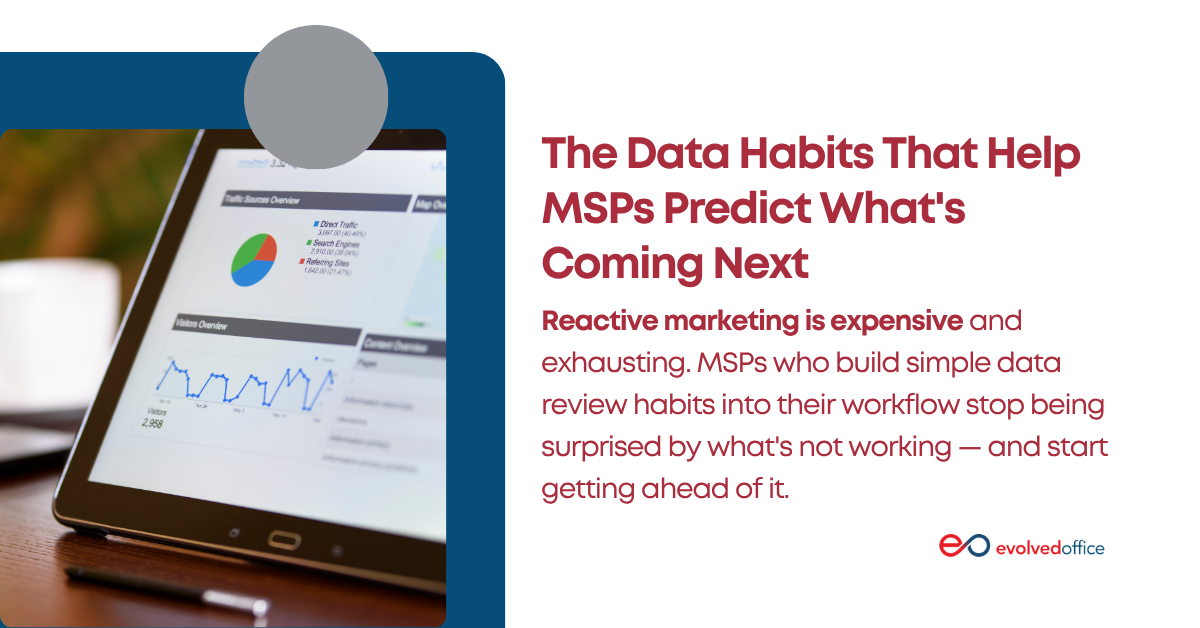
Most MSPs don’t have a data problem. They have an MSP data habits problem — and it quietly damages every marketing decision they make.
The dashboards exist. The campaign reports are there. But without a consistent habit of reviewing and acting on that data, marketing runs on gut feel. Campaigns repeat because they always have. New tactics get abandoned before the data has anything useful to say.
The fix isn’t more data. It’s a simpler, more consistent review process tied to the right metrics — and the discipline to act on what comes back.
Why Reactive Marketing Costs MSPs More Than They Realize
Reactive marketing has a price that rarely shows up on a single line item.
It’s the campaign that ran for three months before anyone noticed the open rate was 6%. It’s the social channel eating budget while generating zero pipeline. It’s the content topic nobody searched for because keyword data was never checked.
According to Forrester Research, companies that adopt data-driven marketing are six times more likely to be profitable year-over-year than those that don’t. For MSPs operating on tight margins, that gap matters. Reactive marketing doesn’t just waste budget — it compounds the waste by repeating the same decisions without knowing if they worked.
The alternative isn’t a full analytics operation. It’s a habit. A regular, structured review of a small number of metrics that actually tell you something useful — and a clear process for acting on what you find.
The Three MSP Data Habits That Actually Move the Needle
Most MSPs who try to get data-driven make the same mistake: they track everything at once. The dashboard gets complicated. The review takes too long. The habit dies by week three.
Start with three habits instead.
Review campaign performance weekly, not monthly. Monthly reviews let bad campaigns run too long. A 15-minute weekly check on email open rates, click rates, and social engagement gives you enough signal to adjust without overwhelming the process.
Track one conversion metric per channel. Pick the single most important action you want someone to take from each channel — a form fill, a demo request, a link click — and track only that for 90 days. Everything else is noise until you understand what drives your primary conversion.
Compare periods, not snapshots. A 12% email open rate means nothing alone. A 12% rate that was 19% three months ago means something’s broken. Always measure performance relative to a baseline — not just the current number.
According to the Content Marketing Institute, B2B marketers who document their metrics and review them consistently report significantly better content performance than those who measure sporadically. The habit matters more than the sophistication of the tools behind it.
When the Platform Gets in the Way of Good MSP Data Habits
Here’s where a lot of MSPs hit a wall. The data review habit sounds manageable. Then they open the analytics platform and spend 45 minutes finding the right report — before giving up and going back to gut feel.
That’s not a data problem. That’s a platform problem.
Enterprise analytics tools are built for marketing teams with dedicated analysts. The dashboards are powerful and deeply complex. They require training to configure and pricing that assumes full utilization. MSPs end up paying for reporting infrastructure they can barely operate — and still can’t get a straight answer about which campaign drove last month’s best lead.
Complexity doesn’t make you data-driven. It makes the habit harder to build and easier to abandon. If that sounds familiar, the comparison is worth your time.
Smarter Reporting With EoDigitalHub
EoDigitalHub gives MSPs a centralized view of marketing performance — campaign results, lead activity, and channel effectiveness — without needing a data specialist to make sense of it.
The reports answer the questions MSPs actually ask. Which campaigns generated pipeline? Which channels drove traffic that converted? Where did leads drop off before reaching sales? Those answers don’t require a custom dashboard or a 90-minute onboarding call. They’re there when you open the platform.
EoDigitalHub connects to CRM and sales tools so marketing activity ties directly to revenue outcomes. The weekly data review becomes a 15-minute check, not a project. It’s purpose-built for your industry needs, which means the metrics that surface are the ones relevant to MSP sales cycles — not e-commerce funnels or SaaS trial-to-paid ratios.
Start your free trial of Evolved Office and see what a clean, actionable marketing review looks like when the platform was built for lean MSP operations.
Building the Habit Before the Year Ends
There’s a practical reason to build MSP data habits now rather than waiting for January.
Q4 is when MSP marketing decisions carry the most weight. Budgets close. Annual plans get made. The campaigns running in October and November shape pipeline well into Q1. Making those decisions based on real data — rather than repeating last year’s approach because nobody reviewed the results — changes what the first quarter looks like.
According to the Small Business Administration, businesses that regularly review and adjust their marketing strategy based on performance data see significantly more consistent revenue growth than those without a review process. The review doesn’t need to be elaborate. It needs to be consistent.
Start with one metric. Review it every week. Make one adjustment based on what you see. Do that for 30 days.
Good data habits build from there — and every marketing decision that follows gets sharper.
Want to see how Evolved Office helps MSPs build a data review process that actually runs? Get in touch and let’s talk about what smarter marketing analytics looks like for your business.